

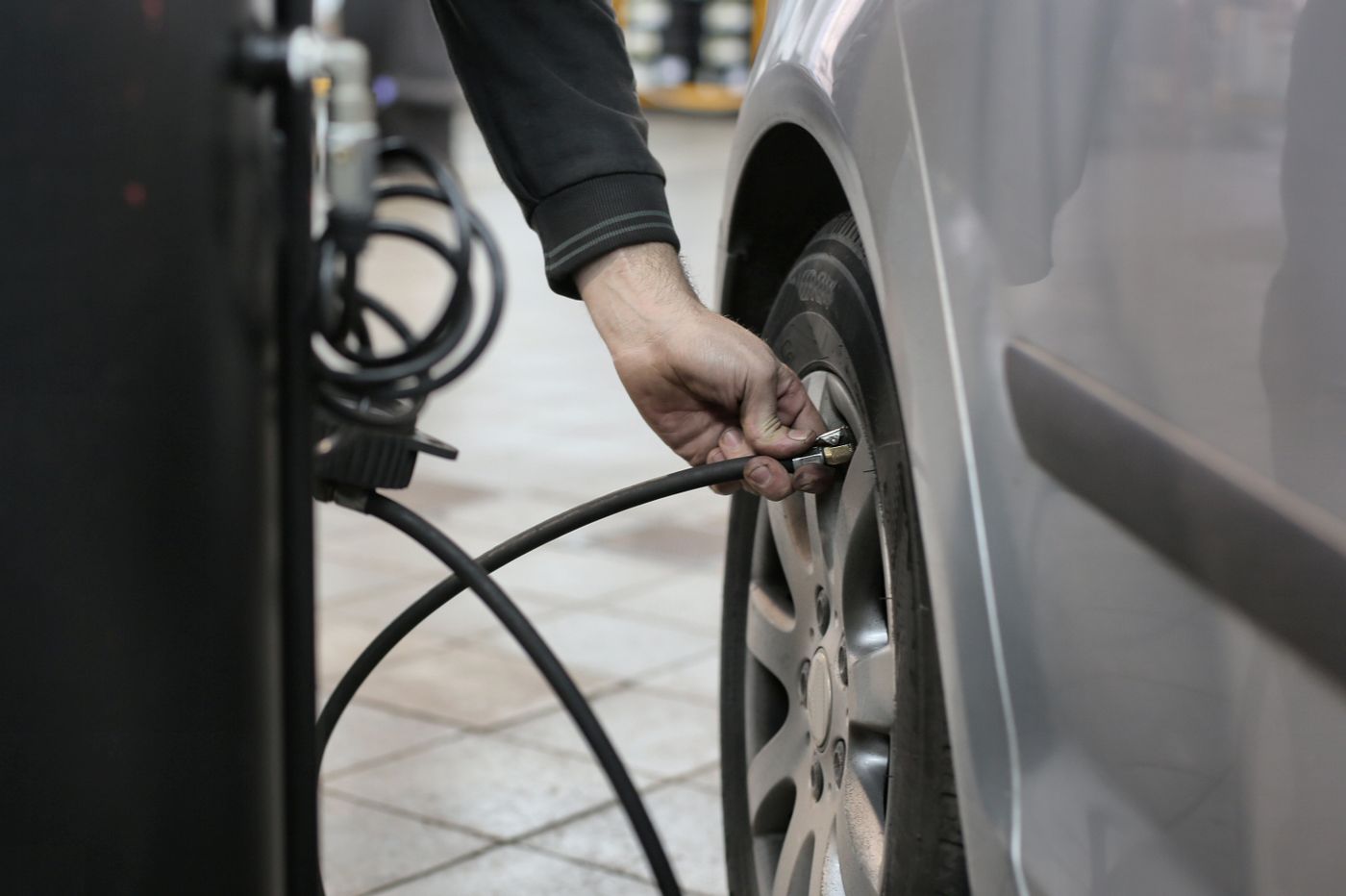
- Cold air shrinks. Your tires lose about 1 PSI for every 10 degrees the temperature drops.
- A cold night can drop a tire low enough to turn on the tire pressure light by morning.
- The light often goes off after a few miles, because driving warms the air back up. The tire is still low. Fill it.
- Use the number on the sticker inside the driver's door, not the number on the tire.
- A light that flashes for a minute and then stays on is usually a sensor problem, not low air.
It is the first cold morning of the season. You start the car, and there it is. That little yellow horseshoe with an exclamation point in the middle.
You walk around the car. The tires look fine. So why is the tire pressure light on?
Almost always, it is the cold. Here is why it happens, what to do about it, and the one version of the light that means something else. We see this every fall at our shop in Goshen, Indiana, and the fix is usually a few minutes at an air pump.
Why the tire pressure light comes on when it's cold
Air shrinks when it gets cold. Less room means less pressure inside the tire.
AAA says tire pressure drops about 1 PSI for every 10 degree drop in temperature. It goes back up at about the same rate when it warms up.
That adds up fast in the fall. Say your tires were set at 35 PSI on a warm September afternoon. A 30 degree morning in November can take them down a few pounds. Add the small amount of air every tire loses over time, and you cross the line where the tire pressure light turns on.
Tires set right. No light. Everything looks normal.
The air inside shrinks. Pressure drops a few PSI while the car sits.
One or more tires dip under the warning point. The light comes on.
Driving warms the air. The light may go off. The tire is still low.
Why the light goes off after you drive
This fools a lot of people. You drive to work, the tire pressure light goes out, and you figure it was nothing.
Here is what happened. Driving heats the tires. Warm air takes up more room, so the pressure climbs back over the warning point. Tomorrow morning it will be cold again, and the light will come right back.
Also, the light does not come on at the first sign of trouble. AAA notes most systems wait until a tire is about 25 percent below the recommended pressure. By the time you see the light, the tire has been low for a while.
Do not ignore it until spring. Low tires wear out faster, waste gas, and grip worse on wet or icy roads. The Car Care Council says proper inflation alone can improve gas mileage by more than 3 percent.
How to fix it in five minutes
- Find your number. Open the driver's door and look for the sticker on the door frame. That is the right pressure for your car.
- Skip the number on the tire. The sidewall shows the most the tire can safely hold, not what your car needs.
- Check them cold. First thing in the morning, before you drive far, gives the truest reading.
- Fill all four. If one is low from the cold, the others probably are too. Check the spare if your car has one.
- Drive a few miles. Most lights reset on their own once the pressure is right. Some cars have a reset button or a menu setting.
A small tire gauge in the glove box is one of the best cheap tools you can own. Many gas stations around Goshen and Elkhart have air pumps with a gauge built in.
What if the tire pressure light is flashing?
A light that stays on means low air. A light that flashes when you start the car, usually for about a minute, and then stays on, means something different on many cars. It is the system telling you it cannot read one of the sensors.
Common reasons:
- A sensor battery died. The sensors inside each wheel run on small batteries that wear out with age.
- A sensor got damaged, often during a tire change or by a pothole.
- Winter wheels without sensors. If you swapped to a second set of wheels for winter, the car may not see them.
Adding air will not fix a flashing light. That one needs a look. Our post on winter tires vs. all-season tires covers the second-set-of-wheels question in more detail.
When the light means a real leak
Cold is the usual reason, but not the only one. Look closer if:
- One tire keeps going low while the other three hold. That points to a nail, a bad valve stem, or a leak where the tire meets the wheel.
- You have to add air every few days. Cold does not cause that.
- The car pulls to one side. A low tire on one side can do it. See why your car pulls to one side.
- The tire looks soft or has a bulge. Do not drive on a bulge. It can fail without warning.
If a tire is flat or badly low and you are not sure it is safe, our post on whether to drive it or tow it helps you decide.
When to bring it in
Bring it to a shop if the light is flashing, if one tire keeps losing air, or if the light stays on after you have filled every tire to the door sticker number. Costs vary by make and model. Call us and we can check it out at no cost.
We can mount tires you already bought, and you can see everything else we work on at our auto repair services page. Getting ready for the rest of the cold season? Our Northern Indiana winter checklist covers the other things that tend to act up when the temperature drops.
Quick answers
Why is my tire pressure light on when it's cold?
Cold air shrinks, so tire pressure drops about 1 PSI for every 10 degrees. A cold night can drop a tire below the warning point by morning. Fill the tires to the number on your driver's door sticker.
Why is my tire pressure light on but my tires look fine?
A tire can be several PSI low and still look normal. Check each one with a gauge. If they are all at the right number and the light is still on, a sensor may need a look.
Why did my tire pressure light go off after driving?
Driving warms the air in your tires, which raises the pressure back above the warning point. The tire is usually still low when it cools down, so add air.
Is it safe to drive with the tire pressure light on?
For a short drive to an air pump, usually yes. Do not keep driving on it for days. Low tires wear faster, grip worse on ice, and can overheat.
Why is my tire pressure light flashing?
On many cars, a light that flashes for about a minute and then stays on means the system cannot read a sensor. Common causes are a dead sensor battery or wheels without sensors.
Light still on? Let us take a look.
Tire pressure light checks at our shop in Goshen, Indiana.
Call (574) 533-9081