

Why Is My Car's AC Blowing Warm Air?

The short version
Warm air almost always means low refrigerant from a small leak — the most common cause we see all summer.
Other suspects: a tired compressor, a dirty condenser, an electrical hiccup, or a stuck blend door.
There’s a 5-minute check you can safely do in your own driveway first.
A recharge is inexpensive; a compressor is the pricey end. We always quote you before any work.
You’re heading down Main Street on a sticky August afternoon, it’s pushing 90 degrees, you flip the AC to full blast and… warm air. If that’s you, you’re in good company — it’s one of the calls we get most once Elkhart County summer really kicks in.
The good news: warm air is usually your car telling you about a small, fixable problem before it turns into a big one. Let’s walk through what’s going on, in plain English, so you know what you’re dealing with before you ever call us.
How your AC actually makes cold air
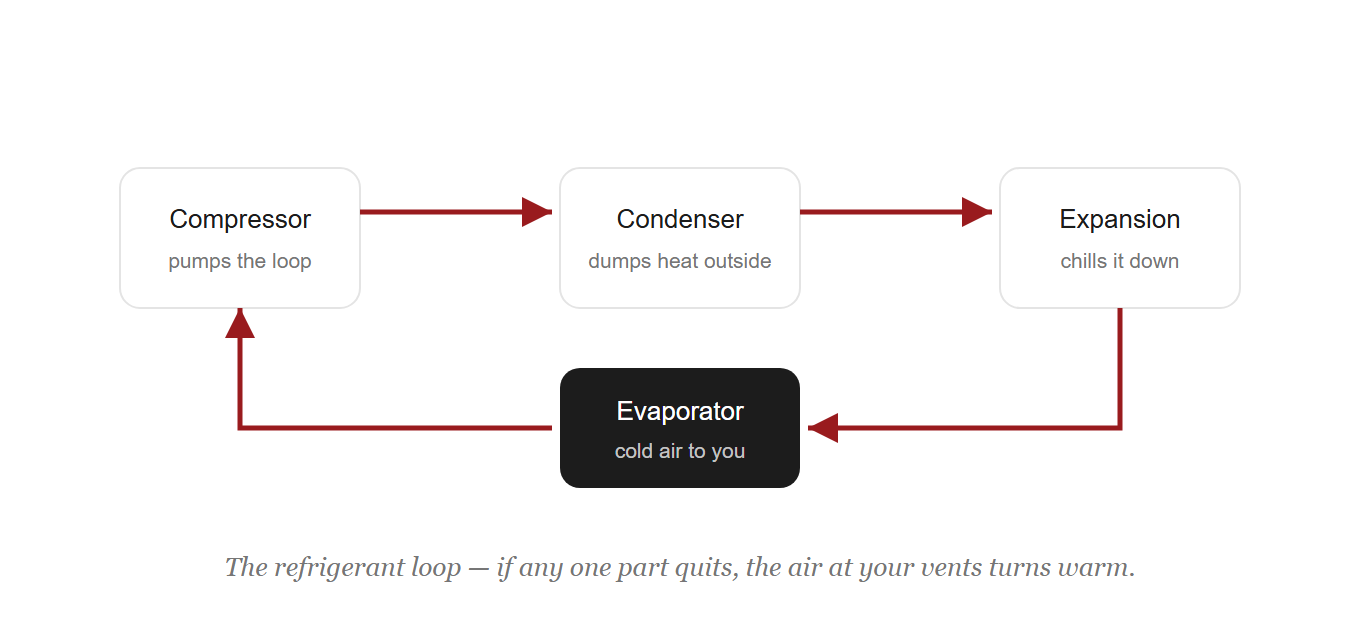
Here’s the part most folks don’t realize: your air conditioner doesn’t make cold. It moves heat out of your car and dumps it outside, by pushing a fluid called refrigerant around a loop. When every part of that loop is healthy, the air at your vents feels cold. When one link is weak, you get warm air.
The 5 most common reasons your AC blows warm
Nine times out of ten, warm air traces back to one of these five things — and the tricky part is they all feel identical from the driver’s seat. Telling them apart is where a set of gauges and a little experience saves you money, because the fix for a $150 problem is very different from a compressor.

Why Goshen summers make it worse
Our corner of Indiana is tough on AC systems, and these calls spike in July and August for a reason. The humidity off the lakes makes your system work overtime. Add the stop-and-go around the 33 bypass and downtown, where your car idles in the heat instead of getting airflow, and a system that was “good enough” in May finally shows its weak spot.
And a lot of our neighbors point the car north for a weekend — up to the Michigan lakes, an hour or two each way. That long, hot highway run is exactly when a marginal compressor or a slow leak decides to quit. Planning a summer road trip? It’s worth getting the AC looked at before you load up the family.
The 5-minute check you can do in your driveway
Before you bring it in, here are a few safe things you can check yourself — just looking and listening, nothing that opens the system:
Feel both sides of the dash. Cold on one vent and warm on another points toward a blend door issue, not refrigerant.
Listen for a click when you turn the AC on. Engine running, switch the AC on and off. A faint click under the hood means the compressor is trying to engage. Silence points toward electrical or the compressor itself.
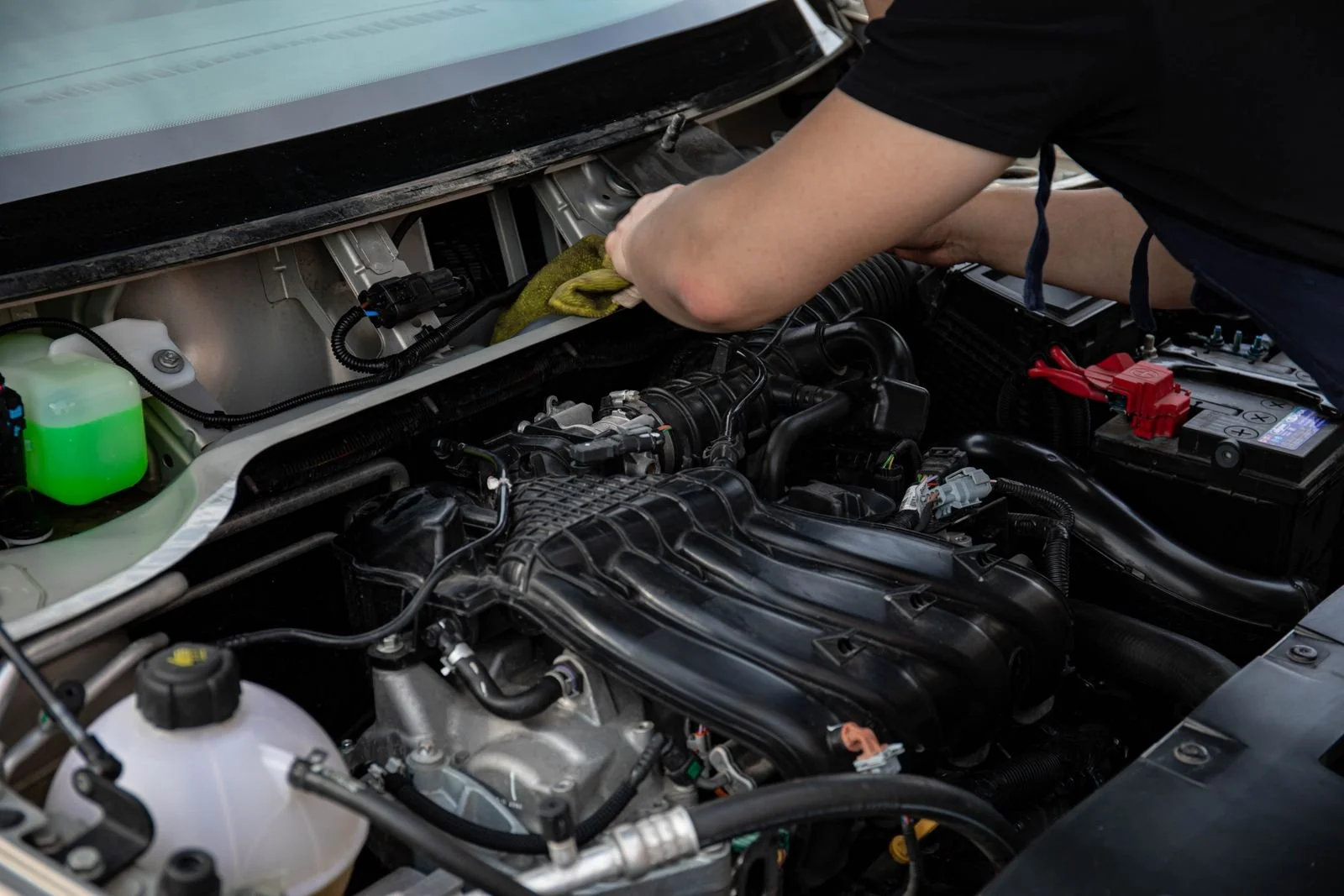
Peek at the front of the condenser. Look through the grille. If it’s packed with bugs, leaves or Indiana cottonwood fluff, that alone can choke your cooling.
One thing to skip: those “just add a can” refrigerant kits. If you’re low, it’s because of a leak, and topping it off masks the problem, can overcharge the system, and the sealant in some cans gums up parts and turns a cheap fix into an expensive one.
What an AC fix usually costs
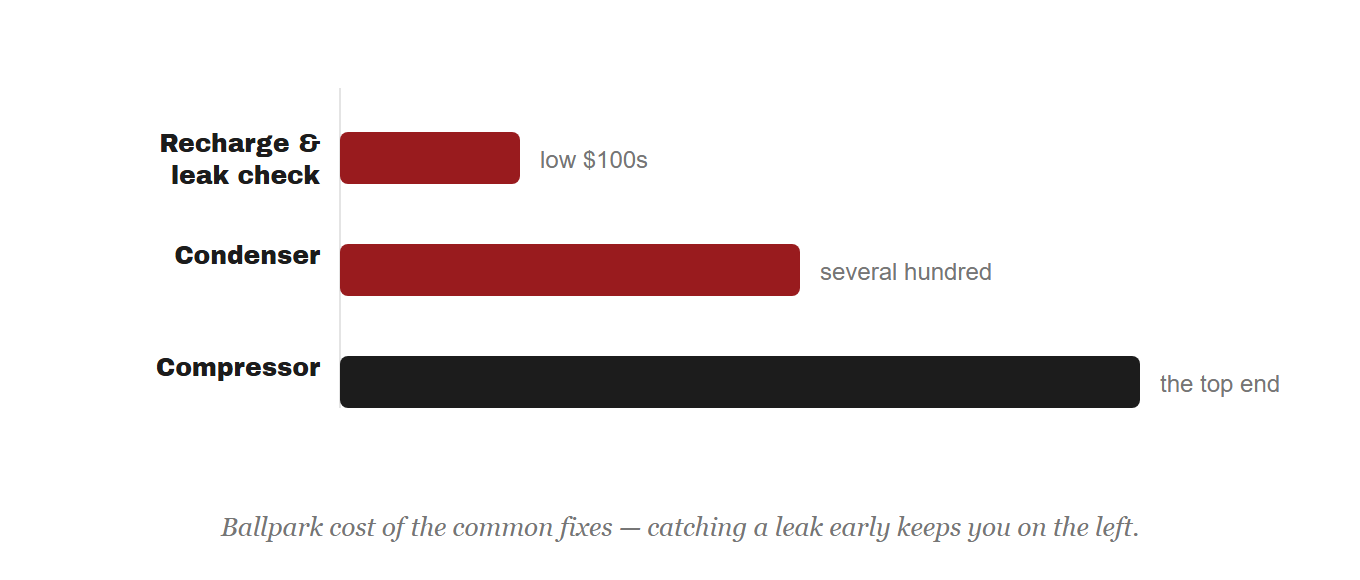
Everyone’s first question — and a fair one. Real numbers depend on your make, model and what’s failed, so treat these as ballpark ranges, not a quote. A leak check is inexpensive, and catching the problem early is what keeps you on the cheap end.
This is exactly why we diagnose first and call you with a number before we do any work. No surprises, no “while we were in there.” You decide with the real information in front of you.
When to bring it to us
If your driveway check didn’t sort it out — or you’d rather have someone who does this every day take a look — that’s what we’re here for. We’ll hook up the gauges, find out whether it’s a simple recharge or something bigger, and give you a straight answer and a fair price. We work on all makes and models, and we treat your car like it belongs to one of our own family — because around here, you kind of do.
Quick answers
Is it bad to keep driving with the AC blowing warm?
It won’t hurt the engine, so you’re safe to drive. But if the cause is a leak or a struggling compressor, it tends to get worse — and more expensive — the longer it’s ignored. Better to catch it early.
How long should an AC recharge last?
A properly sealed system holds its refrigerant for years. If your AC “runs out” a season or two after a recharge, that’s not normal — it means there’s a leak that needs to be found and fixed, not just topped off again.
Can I just use a recharge can from the parts store?
We’d steer you away from it. If you’re low, you have a leak, and those cans mask it. The sealants in some can also clog parts and turn a small repair into a big one. Finding the leak first almost always costs less overall.
Do you work on all makes and models?
Yes — domestic and import, cars and trucks. If it’s got an AC system, we can look at it.
I’m in Elkhart or Middlebury, not Goshen — can you still help?
Absolutely. We take care of drivers all across Elkhart County and the surrounding towns, and folks close to the Michigan line too.